
Fibreglass flexes more, feels softer and costs less. Carbon is stiffer, more responsive and more durable. The weave numbers — 3K, 12K, 18K, 24K — describe the construction of the fibre, not its quality, and a higher number does not mean a better racket.
What the face does
The face is the flat surface of the racket, bonded over the foam core. It determines how much the hitting surface flexes on impact, how quickly it returns energy to the ball, and how much shock reaches your hand.
It matters — but less than shape, weight, balance or core firmness, and considerably less than the marketing around it implies.
Fibreglass
Flexible, forgiving, comfortable and inexpensive. A fibreglass face deforms more on contact, which spreads the impact over a longer moment and softens the feel. That flex is also why fibreglass frames are more forgiving off-centre.
The trade is responsiveness. A fibreglass face returns less energy, so you supply more of the pace yourself. For a player who isn't swinging hard enough to compress a stiff face anyway, that is not a real loss.
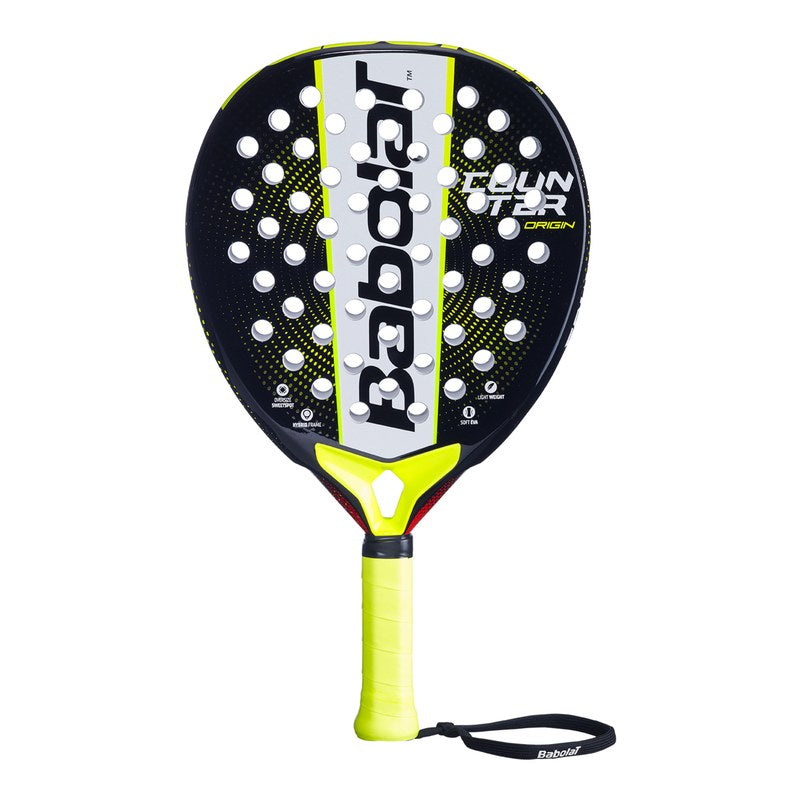
Fibreglass is not a budget compromise. It is the correct material for most club players, and several of the best-selling frames in the world use it deliberately, including at prices well above entry level. Three fibreglass-faced frames from our shelf — a round beginner's racket, a soft diamond and a tour-brand all-rounder — with live prices:


Carbon
Stiffer, more responsive, more durable and more expensive. A carbon face deforms less, so more of your swing energy goes back into the ball. For a player generating real racket-head speed, that is a genuine advantage.
Carbon also transmits more of the impact to your arm. If you have any elbow or shoulder history, a stiff carbon face over a firm core is the combination most likely to aggravate it.
What 3K, 12K, 18K and 24K mean
Carbon fibre is woven from bundles of filaments. The number tells you how many thousand filaments are in each bundle — 3K is three thousand, 24K is twenty-four thousand.
It is a description of the weave, not a quality rating. Read that sentence twice, because the entire industry markets these numbers as though bigger is better.
- Lower numbers (3K, 6K) — fewer filaments per bundle, a tighter and generally stiffer weave. Often used where a brand wants a firm, responsive, controlled feel.
- Higher numbers (18K, 24K) — more filaments per bundle, a broader and often softer weave. Frequently the more comfortable and more forgiving option.


Aluminised, PTFE-coated and other terms
Brands apply various treatments over the weave. Aluminised carbon adds a metallic layer that changes stiffness and appearance. PTFE coatings reduce surface friction. These are real engineering choices with real effects, but they are refinements — they will not turn an unsuitable racket into a suitable one.
So which should you buy?
Buy the shape, weight, balance and core that suit you first — our how to choose a padel racket guide walks through all four. Then take whichever face material the rackets meeting that description happen to have. In practice the face tends to sort itself out: entry and mid-tier frames use fibreglass or a soft graphite, performance frames use carbon, and both of those conventions exist for sound reasons.
The one time to override that: if you have arm trouble and are choosing between two otherwise identical frames, take the fibreglass one, or the higher-K carbon.
Every product page in our range lists the exact face material the manufacturer publishes, and we group them into filterable bands so you can narrow by it if you want to.
Filter by face material
Fibreglass through to 24K carbon, on every racket we range.
Written by the Australian Padel Shop team and last reviewed on 12 September 2026. Prices on this page are pulled live from our catalogue. We publish the manufacturer's specification for every product and record where and when we checked it. Where we haven't tested something ourselves, we say so.