
Padel rackets have no strings, so more impact reaches your arm than in tennis. Four equipment choices genuinely reduce that load: a softer core, a round head, a low balance, and a grip you do not have to squeeze. None of them treat an injury. If your elbow has hurt for more than a couple of weeks, see a physio or your GP before you buy anything.
Why padel loads the arm more than people expect
In tennis, the string bed deforms on contact and absorbs a large share of the impact before it reaches your hand. A padel racket has no strings. There is a solid face bonded over an EVA foam core, and the only thing damping the hit is how much that foam compresses.
So the spec that matters most for your arm is not weight, and it is certainly not brand. It is core firmness — and it is the spec most retailers do not publish.
Three things stack on top of that. A head-heavy balance puts mass further from your hand, so every off-centre hit twists the frame and your forearm resists it. A diamond head shrinks the sweet spot, which means more off-centre hits. And a tight grip — the single most common cause, and the one nobody sells you anything for — turns your forearm into a rigid rod that conducts every bit of shock straight to the elbow.
The four changes worth making
1. Loosen your grip. This is free.
Most club players hold the racket far harder than they need to, and tennis converts are the worst offenders. A relaxed hand lets the racket move slightly on impact and absorbs shock that would otherwise reach your elbow. If you take one thing from this page, take this one, because it costs nothing and it does more than any purchase below.
The practical problem is that people squeeze because they are afraid the racket will turn in their hand — which brings us to the grip.
2. A grip you don't have to squeeze
A Hesacore is a moulded base grip that replaces the one your racket came with. Its hexagonal surface gives the hand something to key into, so you can hold the racket securely without clamping it. That is the whole mechanism, and it is why it has a following among players with forearm, wrist and elbow complaints.
Pick by hand size: Extra Small 1.0mm for small hands, Small 1.5mm for most people, Medium 2.0mm for large hands or anyone who likes a chunky handle. Wrap your usual overgrip over the top.


A thicker handle in general — whether from a base grip or an extra overgrip — tends to reduce how hard people grip. It is a cheap experiment.
3. A softer core and a rounder head
If you are buying a racket anyway, buy for comfort first and performance second. We flag frames as arm-friendly on the product page when the manufacturer states a soft core, or the build is light and handle-biased, or both — and you can filter the whole range by it.


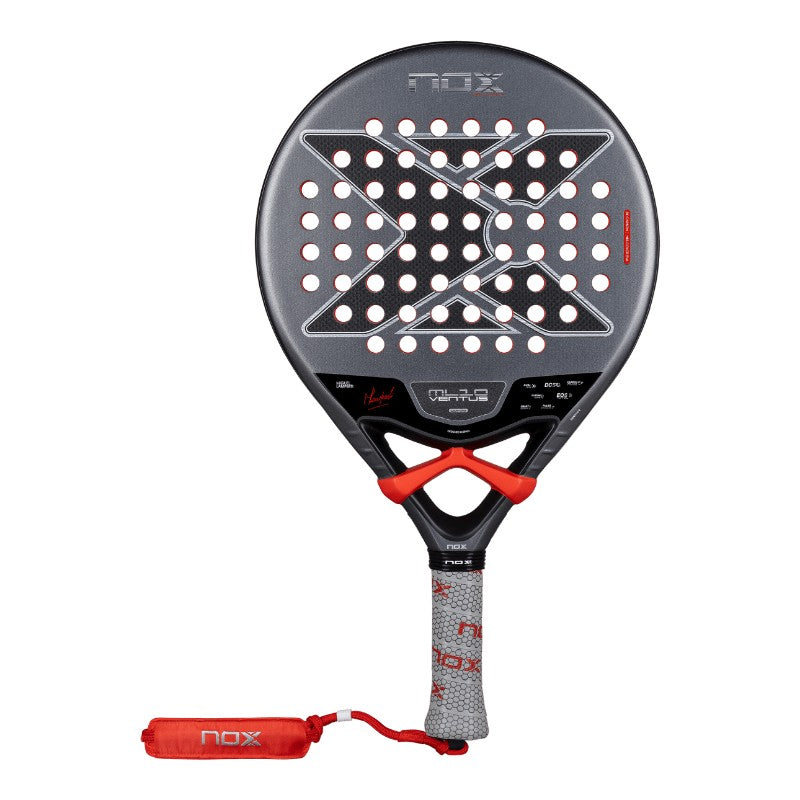

What to avoid while your arm is unhappy: diamond heads, high balance, firm carbon over firm EVA. That combination is the most demanding in the sport and it is the wrong place to be. The control shortlist is the right end of the wall; carbon vs fibreglass explains why a higher-K weave is often the softer one.
Every arm-friendly racket we stock →
4. Replace a dead racket
An overlooked one. As the EVA core fatigues it stops absorbing shock, so an old racket transmits noticeably more vibration than the same racket did when it was new. If your arm started complaining and nothing else changed, check the frame's age before you blame yourself — see how long a padel racket lasts.
What doesn't help
Vibration dampeners. They are a tennis product and they work on the string bed. A padel racket has no strings, so there is nothing for one to dampen. Anybody selling you one for padel is selling you a tennis part.
Buying a lighter racket and nothing else. Weight is the spec everyone reaches for and it matters less than core firmness and balance. A light, head-heavy, firm-cored frame can be harder on the arm than a heavier, handle-biased, soft one.
Playing through it. Tendon problems reward early attention and punish being ignored. Loading that is comfortable is fine; loading that hurts, is not.
Before you buy anything
If the pain is new and mild, the free changes are the first move: loosen the grip, shorten the swing, warm up properly, and stop playing the session out if it is getting worse.
If it has been there for weeks, is waking you up, or is affecting your grip strength off the court, see a physiotherapist. Tendon issues respond well to graded loading programmes and badly to guesswork, and no racket on this page is a substitute for one. We would rather you came back and bought a racket in six weeks with a working arm than bought one today.
Filter the range by arm comfort
The finder asks about arm sensitivity and weights the result accordingly — it is the second-heaviest factor in the score.
Written by the Australian Padel Shop team and last reviewed on 12 September 2026. Prices on this page are pulled live from our catalogue. This page describes how equipment choices change the load on your arm. It is general information about padel gear, not medical advice, and it is not a diagnosis or a treatment for any condition — for that, see a qualified health professional.